


Picture this: you’re three meetings deep with a potential acquirer, and your CTO is walking their team through your detection architecture. Their questions are getting sharper, more technical. One of their engineers is scribbling notes about your machine learning models, the threat intelligence pipeline that took five years to build, and the specific detection thresholds that make your product unique.
Three months later, the deal collapses. Six months after that, your competitor launches a feature that looks remarkably similar to what you demonstrated in that room.
Scenarios like this become more common as deal volumes rise. In 2025, the cybersecurity sector recorded 426 M&A transactions, a 5% increase over 2024 and the highest volume since 2022. Disclosed deal value reached $92.5 billion, driven largely by strategic acquirers such as Google, which agreed to buy Wiz for $32 billion, and Palo Alto Networks, which agreed to buy CyberArk for $25 billion, while private equity-led acquisitions fell to 18. The difficulty is that the strategic buyer sitting across the table is often also a capable competitor.
Why strategic buyers pay more (and demand more)
Strategic acquirers typically pay premiums above financial buyers when synergies are demonstrable. They pay more because they can integrate your detection logic with their platform, cross-sell to their customer base, and consolidate a competing product in one transaction. But those synergies are only valuable if the acquirer truly understands what it’s buying.
The information a strategic buyer needs to justify its premium is the same information that could damage you if the deal doesn’t close. Your detection logic, threat intelligence methodology, ML models, and specialist engineering talent are valuable precisely because they’re secret. Disclosure to a competitor creates a one-way information flow that can never be reversed.
What’s actually at risk
Four categories of assets are most exposed during a cybersecurity sale process:
Detection logic and threat content
Signatures, behavioural heuristics, and attack pattern libraries are operational core assets. Unlike patents, which are protected in exchange for publishing the invention, detection logic is valuable only while it remains unknown. A strategic buyer who learns precise detection thresholds or coverage gaps can design products and marketing strategies that exploit that knowledge.
Proprietary models and training data
Machine learning models trained on years of proprietary telemetry represent thousands of hours of work. A competitor who examines model architecture during diligence gets a tutorial on your most defensible asset. Companies increasingly rely on trade secret law to protect algorithms and training data, but that protection has real limits: it does not prevent a competitor from developing similar capabilities independently or by reverse engineering, and proving that a buyer misused what it saw during diligence is difficult and slow. Prevention is the only reliable protection.
Threat intelligence relationships
Intelligence community partnerships, government data-sharing arrangements, and dark-web collection methodologies distinguish tier-one vendors. These relationships carry national security dimensions that cannot be unwound if disclosed prematurely, and some may be legally restricted from disclosure altogether where classified information is involved. Government relationships also shape which buyers can realistically be cleared, as set out in our analysis of government revenue in cyber M&A.
Engineering talent
Acquirers weigh key-person risk particularly heavily in cybersecurity, where a small number of researchers often embody the product. A failed process that exposes your talent roster to a competitor creates a secondary acquisition risk that unfolds slowly, one resignation at a time.
The legal frameworks: what the law actually protects
Directive (EU) 2016/943 establishes a harmonised definition of trade secrets across the EU: information that is secret, has commercial value by reason of secrecy, and has been subject to reasonable steps to keep it secret. The Directive defines unlawful acquisition to include any conduct contrary to honest commercial practices.
The third condition matters most to a seller. How information is handled during a sale process is itself part of the “reasonable steps” a court will examine, so a disciplined disclosure process helps preserve the legal protection as well as the commercial value, and loose disclosure during a failed process can weaken a later claim.
The United Kingdom implemented this through the Trade Secrets (Enforcement, etc.) Regulations 2018, which came into force on 9 June 2018. Post-Brexit, UK law maintains this framework independently, reinforced by the equitable doctrine of confidence.
Germany implemented the Directive through its Trade Secrets Act (Geschäftsgeheimnisgesetz) in 2019, and German courts apply its requirement for appropriate confidentiality measures strictly, expecting documented and proportionate protection rather than general assertions of secrecy. Switzerland sits outside the EU framework and protects trade secrets through its Unfair Competition Act and Criminal Code, so for a Swiss target the interaction between the NDA and those provisions should be confirmed with Swiss counsel.
The law gives sellers a remedy after the event, but litigation is slow, expensive and uncertain, so the real protection has to come from how the process is run.
Competition law: the reason clean teams exist
When the buyer is a competitor, protecting intellectual property is only half of the problem. Exchanging competitively sensitive information with a competitor before closing, such as pricing, customer terms, pipeline or product roadmaps, can infringe Article 101 TFEU and its national equivalents, and acting on that information before clearance can amount to gun-jumping. Competition authorities take this seriously: in June 2025 the European Commission fined Delivery Hero and Glovo €329 million in a case that included the exchange of commercially sensitive information between competitors, and in which it sanctioned a no-poach agreement for the first time.
The standard answer is a clean team: a small, ring-fenced group, typically the buyer’s external advisers and a limited number of employees with no involvement in competing product development, pricing or sales, who review the most sensitive material under a written protocol and report only aggregated or anonymised conclusions to the buyer’s deal team. Restricting who sees the information protects the seller far more effectively than technical controls on the data room, because watermarking and download restrictions cannot stop an engineer from remembering what they saw.
Staged disclosure: the architecture of controlled transparency
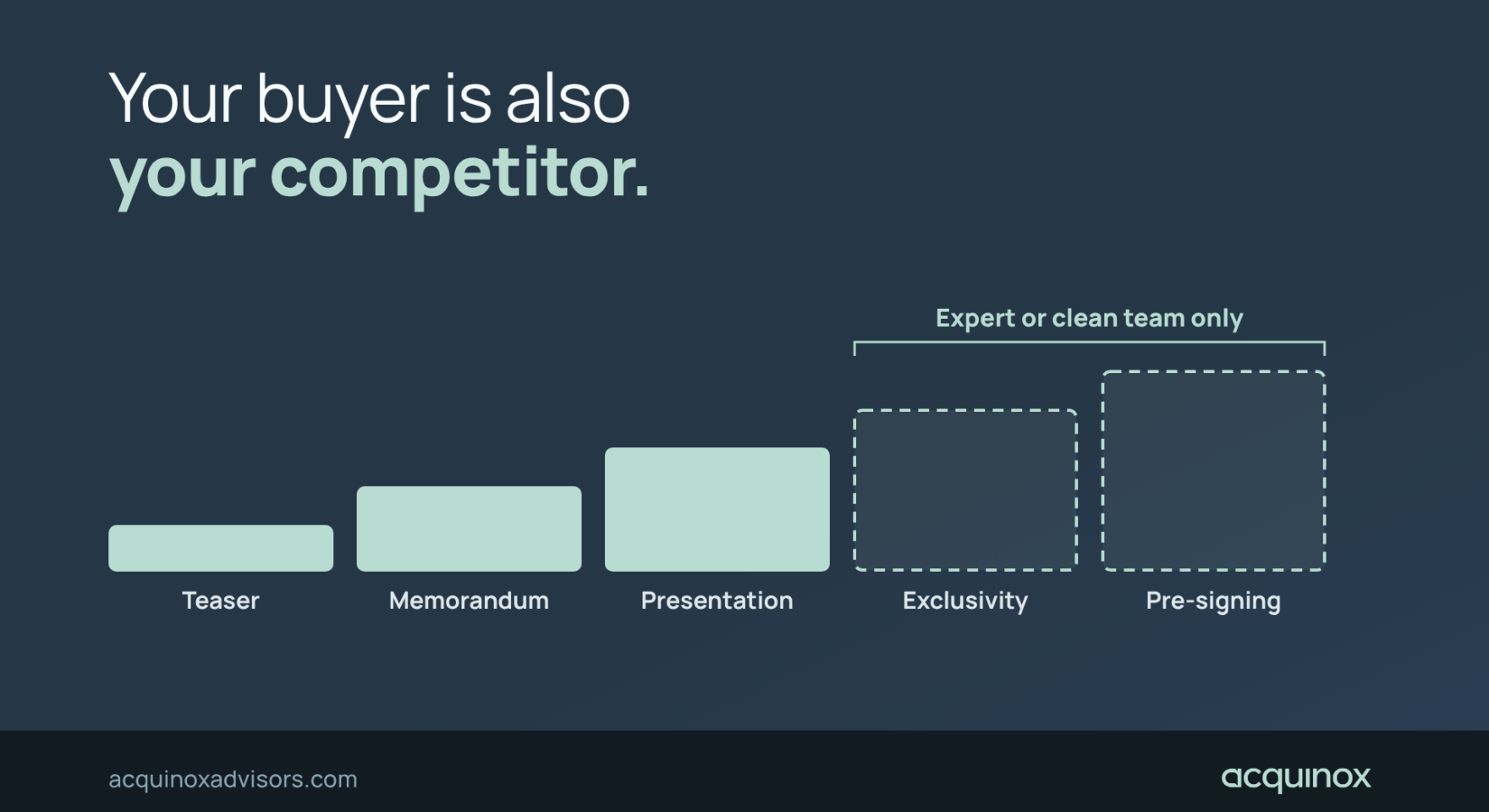
The fundamental tool for managing competitor-buyer risk is staged disclosure: a structured process that aligns the depth of information shared with the buyer’s demonstrated commitment. Instead of opening a comprehensive data room to all qualified buyers, a disciplined M&A process operates as a series of gates.
| Stage | Phase | Information shared |
| Stage one | Blind teaser | Anonymised financial scale and market position only. |
| Stage two | Information memorandum | High-level technology descriptions and revenue models. |
| Stage three | Management presentation | Initial data room, covered by the enhanced NDA. |
| Stage four | Clean team and expert review | Independent expert review of code, models and detection libraries, with findings reported to the buyer. |
| Stage five | Confirmatory disclosure | Customer and partnership information through the clean team, immediately prior to signing. |
Stage one: blind teaser
A two-to-three page anonymised summary before any NDA is executed. Financial scale and market position only. No product architecture, no customer identity, no personnel information. In a niche segment with a handful of credible competitors, even an anonymised teaser can be identifiable on sight, so it should describe the business in broad terms and go only to buyers the seller is prepared to have learn about the process.
Stage two: confidential information memorandum
After the enhanced, cybersecurity-specific NDA described below, a fuller picture: market positioning, revenue model, high-level technology description. Detection logic and model architecture are described only categorically.
Stage three: management presentation
Qualified buyers who’ve submitted indications of interest access management presentations and an initial data room, already covered by the enhanced NDA and limited to commercial, financial and legal material.
Stage four: clean team and independent technical review
Once a buyer has submitted a letter of intent and entered exclusivity, the most sensitive technical material should still stay out of its hands, including source code, detection rule libraries and model weights. An independent technical expert, appointed under a protocol agreed by both sides, reviews the material and reports findings on quality, ownership and risk to the buyer, using the same workstreams set out in our guide to technical due diligence, while commercially sensitive information goes only to the clean team. Access controls, watermarking and download restrictions remain useful, but as a second line of defence.
Stage five: confirmatory disclosure
Customer names and contract terms, partnership details and the vulnerability research pipeline are shared only in the final phase, immediately before signing and through the clean team. Some categories should never reach a competitor at all: customer security data is subject to GDPR and to customer confidentiality obligations, and details of government or intelligence partnerships may be legally restricted from disclosure.
NDA architecture: the carve-outs that matter
Standard confidentiality agreements used in generalist M&A are often inadequate for cybersecurity transactions. The NDA must explicitly enumerate categories of information receiving heightened protection:
Detection logic and content
Signatures, Sigma rules, behavioural heuristics, and attack pattern libraries. The NDA must make explicit that these materials may not be used to develop, calibrate, or validate the buyer’s own products.
Machine learning models and training data
Model architectures, hyperparameters, training datasets, and validation methodology. The prohibition must extend to “use” as well as “disclosure”.
Threat intelligence methodology
Collection sources, correlation methodology, attribution frameworks, and any information about intelligence community partnerships.
Non-solicitation of engineering staff
A carefully calibrated restriction on soliciting named key researchers reflects competitive risk better than generic terms. A non-solicitation undertaking given by a buyer in a transaction NDA is generally enforceable if it is reasonable in scope and duration, which is a different question from the employee non-compete restrictions that courts scrutinise heavily. The competition law risk runs the other way: the Delivery Hero and Glovo decision showed that no-poach arrangements between competitors which are not genuinely tied to a transaction can be treated as a cartel, so the clause should be limited to the transaction, to named individuals and to a defined period, typically one to two years.
The cybersecurity-specific provisions should survive termination of the process for a period that matches the sensitivity of the information. The most robust approach is for confidentiality over genuine trade secrets, such as detection logic and model architecture, to continue for as long as the information remains a trade secret, with a fixed term of several years for other confidential information, which comfortably exceeds the two-to-three-year development cycles typical of cybersecurity products.
Running the process: discipline as value creation
Running a cybersecurity sale in a market populated by competitor buyers requires stringent discipline, because information control is what allows a seller to keep strategic buyers competing for the asset without handing any of them the product. For the founder whose CTO walked a competitor through the detection architecture three meetings into the process, it would have looked different: an enhanced NDA before the information memorandum, a clean team agreed in writing before any technical discussion, an independent expert reviewing the code and models in place of the buyer’s engineers, and a decision, made at the outset, about what would never be disclosed at all. Specialist advisers who have run processes like this can build that discipline in from the first teaser, protecting both the valuation and the intellectual property behind it. Contact Acquinox Advisors today to structure a secure M&A process that protects your critical IP.