



TL;DR: Industry consolidation creates time-limited premium exit windows. Business owners in consolidating sectors like HVAC, mortgage banking, manufacturing, aerospace, defence, and professional services should evaluate exit timing carefully. Early sellers in consolidation cycles typically command significantly higher valuations than late-cycle sellers. Current market conditions (2025–2026) present favourable opportunities in multiple sectors.
Key takeaways
- Consolidation creates rare exit windows: Industry consolidation drives premium valuations through buyer competition, strategic value, and valuation arbitrage. These windows are time-limited.
- Early sellers win: Companies that sell early in a consolidation cycle command the best multiples and terms. Late-cycle sellers face compressed valuations and reduced leverage.
- Know the signals: Watch for accelerating competitor acquisitions, unsolicited buyer inquiries, PE platform announcements, and increased M&A adviser activity in your sector.
- Positioning is critical: Clean operations, growth trajectory, transferable customer relationships, and scalable business models dramatically increase your acquisition value.
- Waiting carries real risk: Businesses that miss the consolidation window face stronger competition from consolidated players and significantly lower exit valuations, if buyers remain interested at all.
Global M&A activity is surging. Full-year 2025 deal volume is likely to close at approximately $4.8 trillion, representing a significant increase over 2024 and the second-highest year on record (Bain & Company), and the money is flowing into specific sectors experiencing rapid consolidation such as mortgage banking, manufacturing, HVAC services, aerospace, defence, and professional services.
If you own a business in one of these consolidating industries, you’re sitting in a rare premium exit window. But here’s what most owners miss: The companies that sell early in a consolidation cycle command the best multiples and terms. Wait too long, and you become “the last small player”, facing dramatically reduced leverage and compressed valuations.
Table of contents
What industry consolidation means for business owners
Industry consolidation happens when M&A activity accelerates to the point where a few large companies begin dominating a market. What was once a fragmented landscape with dozens of regional or specialised players transforms into an oligopoly of well-funded platforms.
As of late 2025, consolidation is accelerating across mature and fragmented industries. For business owners in these sectors, the next 18 to 36 months may represent the best exit window you’ll see for a long time. The key is recognising the opportunity before it passes.
Why consolidation creates premium exit windows
Valuations surge during consolidation for reasons that go far beyond your bottom line.
Buyer competition drives prices up. Multiple investment firms and strategic buyers compete for quality targets, creating bidding tension that inflates purchase prices. When five serious buyers want your business instead of one, your negotiating position strengthens exponentially. In hot consolidation markets, sellers regularly see offers significantly above their expected valuation simply due to competitive dynamics.
Strategic value trumps financial performance. Larger platform buyers evaluate targets based on what you add to their ecosystem, e.g. customer base, geographic coverage, service capabilities, technical expertise. Your company might be worth significantly more as part of a larger platform than it would ever be worth standalone, even if your cash flow is modest.
Valuation arbitrage creates buying urgency. Private equity firms acquire smaller companies at lower-middle-market multiples (typically 5–7x EBITDA), consolidate them into platforms, then sell those platforms at higher multiples (often 10x or more) (CLFI). This arbitrage creates powerful incentives to pay premiums for the right add-on acquisitions. You benefit from this arbitrage when you sell into an active consolidation wave.
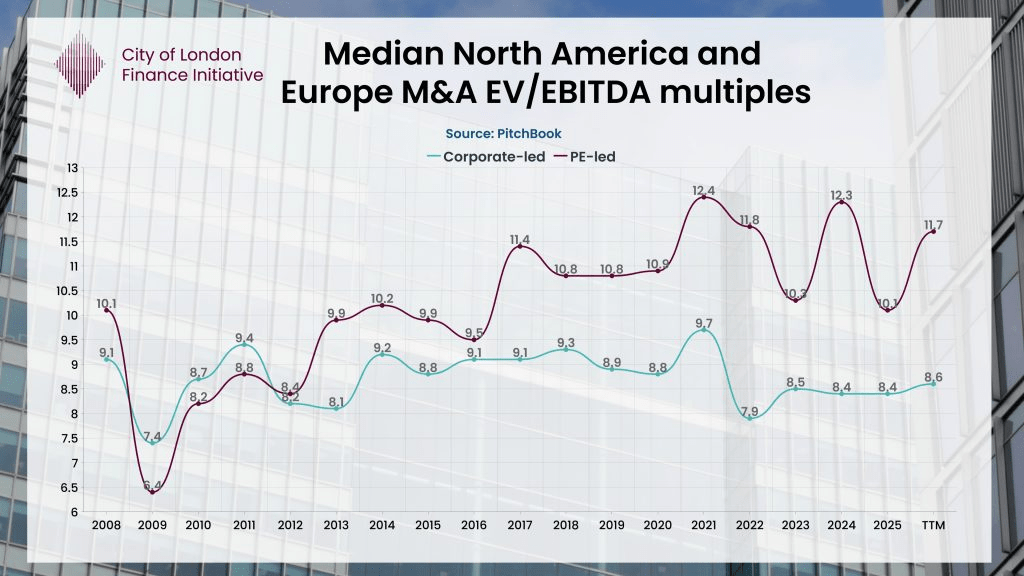
Image credit: CLFI
Capital Needs Deployment. When consolidation heats up, buyers have committed capital sitting idle that needs deployment. This urgency works in your favour, particularly if you’re well-prepared and can move quickly through due diligence. Private equity funds typically have 3–5 year investment periods, creating time pressure that savvy sellers can leverage.
Typical EBITDA multiple ranges by company size and buyer type (2025)
| Company Size | Typical Multiple Range | Buyer Type |
| Small add-on ($1–10M revenue) | <3–6x EBITDA | Platform buyers, PE add-ons |
| Lower middle market ($10–50M) | 5–8x EBITDA | PE platforms, strategic buyers |
| Middle market ($50–250M) | 7–10x EBITDA | Strategic buyers, large PE |
| Platform exits | 10–15x EBITDA | Strategic buyers, secondary PE |
Sources: industry research, typical ranges in 2025
Identifying consolidation signals in your industry
How do you know if consolidation is happening in your sector? Watch for these signals:
- Competitors are getting acquired at an accelerating pace. If you’re hearing about competitors selling to private equity or larger strategic buyers, consolidation has begun. Pay attention to who’s buying and at what multiples.
- You’re receiving unsolicited buyer inquiries. When investment bankers, private equity firms, or strategic buyers start calling to express interest in your business, it’s not random. They’ve identified your industry as a consolidation target and are building lists of acquisition candidates.
- Industry conferences are dominated by M&A talk. When your annual industry event shifts from operational topics to acquisition strategies, exit planning, and deal structures, consolidation momentum is building fast.
- Private equity firms are announcing platform acquisitions. Watch for press releases about PE firms acquiring platform companies in your space with stated intentions to pursue aggressive add-on strategies. These announcements are literal roadmaps telling you who’s buying and what they’re looking for.
- Professional service providers are swarming your industry. When you notice more investment bankers, M&A solicitors, and business brokers specialising in your sector, they’re responding to deal flow that’s already happening.
Positioning your company as an attractive acquisition target
Whether you’re positioning as a platform company or an add-on acquisition, certain characteristics dramatically increase your value.
Clean operations are non-negotiable. Buyers want documented processes, professional financial records, and systems that don’t depend entirely on the owner’s personal involvement. Start cleaning up operations years before you plan to sell, not months.
Growth trajectory matters more than absolute size. Companies showing consistent revenue growth or clear expansion potential command premium multiples. Stagnant or declining businesses get heavily discounted, even in hot consolidation markets. A $5M business growing at 15% annually is often worth more than a $10M business with flat revenue.
Complementary geography or services create strategic value. If you operate in markets the platform doesn’t yet serve, or offer services that complement their existing capabilities, your strategic value increases substantially. This is where you can command multiples well above industry norms.
Customer relationships must be transferable. Documented, long-term customer relationships, especially contracts or recurring revenue, make your business more attractive and less risky for acquirers. If every customer relationship depends on your personal rapport, your business is much harder to sell.
Your model needs to scale without you. Buyers want to understand how your business can grow as part of a larger platform. If expansion requires your personal involvement in every transaction, that’s a serious obstacle to getting deals done.
Don’t wait too long. Act early and strategically.
Here’s what many business owners don’t realise: Timing within a consolidation cycle matters as much as the consolidation itself.
The best acquisition targets get absorbed first. Companies with strong financials, clean operations, and strategic value sell early at premium multiples. What remains are lower-quality assets that buyers can afford to be selective about.
Remember thatt the window doesn’t stay open indefinitely. Business owners who recognise consolidation trends early, prepare their companies thoughtfully, and engage with buyers strategically capture the highest valuations and best terms. Those who wait, hoping to see where the market goes, or believing they can always sell later, often discover that the premium window has closed.
By the time they’re ready to sell, consolidation has matured, competition from larger players has intensified, and valuations have compressed. The opportunity that was worth 7–8x EBITDA two years ago is now worth 4–5x, if there are buyers at all.
If you’re considering an exit in the next few years and operate in a consolidating industry, now is the time to begin preparation. Market conditions are favourable, buyers have capital to deploy, and quality businesses are commanding strong valuations.
Your premium exit window is open right now. Don’t let it close while you wait to see what happens next.
This article has been prepared by Acquinox Advisors using data from Bain & Company, CLFI, Pitchbook, amongst others. This content is for informational purposes only and does not constitute financial, legal, or investment advice. Readers should consult qualified professional advisers before making business sale decisions.
FAQ
How long does a consolidation window typically stay open before valuations decline?
Consolidation cycles typically last 3-7 years in most industries. However, the highest valuations typically occur during the early-to-middle phases when buyer competition is most intense. If you’re seeing early consolidation signals today, your optimal exit window is likely within the next 2–5 years, depending on industry-specific dynamics. Consulting with an M&A adviser familiar with your sector can help pinpoint timing more precisely.
How do I determine if my industry is actually consolidating or if it’s just normal M&A activity?
Consolidation is marked by multiple platform buyers actively pursuing serial acquisitions, increasing deal frequency, and rising valuations. Look for patterns, not isolated transactions. If you’re seeing 5–10 deals per year in your sector with multiple PE firms competing for similar targets, that’s consolidation. If you’re only seeing occasional transactions at typical multiples, it’s regular M&A activity.
Will approaching buyers make me look desperate or hurt my negotiating position?
Proactively engaging with strategic or financial buyers when you’re not desperate actually strengthens your position by demonstrating confidence and allowing you to control timing. The key is approaching from a position of strength with strong financials, clean operations, and genuine optionality. Desperation comes from approaching buyers when your business is struggling or you need to sell immediately, not from strategic, early-cycle outreach.
What happens to small businesses that don’t sell during a consolidation wave?
Small businesses that don’t sell face increased competition from larger, consolidated competitors with economies of scale, better technology, stronger talent, and more favourable pricing power. Many become permanently disadvantaged and either exit later at significantly lower valuations or struggle to remain viable as independent entities. Some find niche positions, but these are exceptions rather than the rule.