


Key insights:
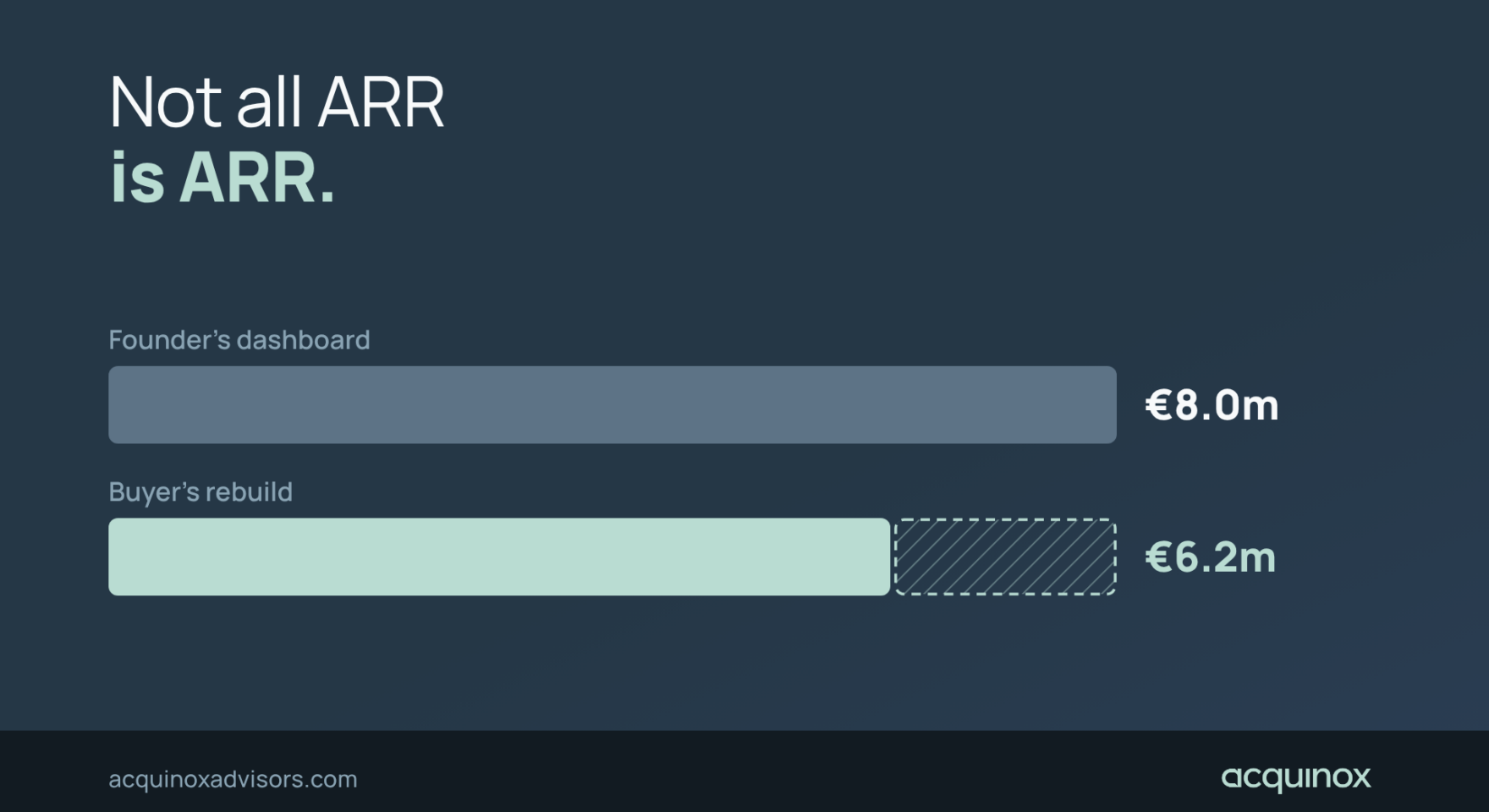
- Buyers rebuild reported ARR from billing data during due diligence, and the result can sit well below the figure on the founder’s dashboard.
- Revenue is tiered based on contract durability and historical retention metrics.
- Regulatory compliance and fully auditable financial systems are critical for premium valuations.
- Executing a remediation plan over the twelve to fifteen months before a sale protects your multiple.
The internal dashboard of a B2B SaaS startup in compliance tech shows €8 million in Annual Recurring Revenue, but the potential buyer’s quality-of-earnings team rebuilds the same figure from the billing system and arrives at €6.2 million. The €1.8 million gap is simply the difference between how founders count recurring revenue and how acquirers underwrite it. Because ARR has no definition under IFRS or US GAAP, each side is free to measure it differently, and sellers tend to count for growth whilst buyers count for contractual durability.
The accounting disconnect: growth metrics vs. contractual durability
ARR measures annualised subscription revenue. Under accounting standards for revenue recognition, revenue follows performance obligations and timing. During due diligence, buyers strip out everything that doesn’t meet their threshold for committed, recurring revenue. Implementation fees, hardware pass-throughs and other one-off items are removed entirely, while uncontracted usage gets heavily discounted. Month-to-month arrangements without commitment history typically receive partial credit at best.
The ARR hierarchy: valuing subscriptions by durability
Transaction advisers typically group revenue into quality tiers along the following lines, and the tier each contract lands in feeds directly into the valuation:
| Tier | Contract type | Valuation impact |
| Tier A | Multi-year subscriptions with automatic renewals | Generally receives full credit at headline multiple |
| Tier B | Annual contracts without auto-renewal | Haircut based on historical retention |
| Tier C | Month-to-month arrangements and pilots | Material discounts, valued closer to services |
| Tier D | One-time fees, hardware and pass-through revenue | Stripped completely from ARR |
Tier A revenue covers multi-year subscriptions with automatic renewals, which buyers treat as the closest thing to contracted future cash flow and credit in full at the headline multiple, provided the renewal history supports it.
Tier B revenue covers annual contracts without auto-renewal, where credit depends entirely on historical renewal performance, so a book that renews at around 90% should expect a discount of roughly 10%.
Tier C revenue covers month-to-month arrangements, pilot programmes and uncontracted usage, which buyers discount materially and often value closer to services revenue than to true ARR.
Tier D revenue is stripped out completely, and includes one-time fees, training, migration services, hardware sales and third-party pass-through revenue.
For context, private SaaS businesses currently trade at around 3 to 7 times ARR, with top performers exceeding 8 times, against a SaaS Capital Index of US-listed public SaaS companies that stood at a median of a little over 4 times run-rate revenue in autumn 2026, and private companies typically trade at a discount to that public benchmark.
Revenue quality findings can damage valuation twice: they shrink the base and compress the multiple on what remains. A €1 million loss of ARR at a 4 times multiple costs €4 million in headline enterprise value. If the same finding drops a firm from the strong growth band to market median, the multiple compresses further. The compliance-tech business from the opening shows how quickly the effect compounds: at 5 times its reported €8 million of ARR it would have been worth €40 million, but at 3.5 times the cleaned €6.2 million it might achieve only €21.7 million.
Where a company lands inside the valuation band gets decided by contract quality, not just ARR size.
Renewal mechanics: pricing the book of business
Term length and renewal mechanics determine what buyers will pay, because they price the renewal book as much as the signed book.
SaaS Capital’s 2026 survey of more than 1,000 private B2B SaaS companies puts median gross retention at 91% and net retention at 103% for bootstrapped businesses with $3 million to $20 million of ARR, while median growth in the same group slowed to 15% from 20% a year earlier. Other panels report weaker retention, with Benchmarkit’s 2026 data showing median gross retention falling to 84%. Buyers will benchmark a target against whichever dataset is closest to it instead of the most flattering one. Companies converting month-to-month users into committed annual or multi-year terms gain real multiple points, and cohort evidence is usually what proves it.
Auto-renewals: powerful but regulated
Auto-renewals create the strongest retention economics, but most of the regulation that attracts attention protects consumers rather than businesses, which matters for software sold to companies. In the United States, a federal appeals court vacated the FTC’s 2024 click-to-cancel rule on procedural grounds in July 2025, but the FTC continues to enforce the Restore Online Shoppers’ Confidence Act, state auto-renewal laws still apply, and EU member states and the UK impose their own consumer subscription rules. Where a business sells to consumers or very small firms, buyers discount non-compliant renewal flows heavily. For B2B contracts the exposure is smaller but still makes a difference, since laws such as New York’s General Obligations Law §5-903 can render an automatic renewal clause in certain service contracts unenforceable where the provider failed to give advance written notice, and buyers will test whether renewals the seller counts as contracted genuinely are.
Change-of-control rights create a separate risk that due diligence will surface, because contracts with large customers that include change-of-control termination rights invite renegotiation at exactly the moment the seller has least leverage.
The pre-sale remediation plan
Well-prepared sellers start preparing for a sale twelve to fifteen months before opening the data room.
Months 1 to 3: diagnostic phase
Build the buyer’s model before the actual buyer does. Produce an ARR bridge showing opening ARR, new additions, expansion, contraction, churn and closing ARR, reconciled to billing and bank data. Disaggregate revenue into subscriptions, usage, services, fees and pass-throughs, each with its own margin line. Rebuild cohort retention from billing data, not CRM dashboards. Inventory your top 25 contracts for change-of-control clauses and renewal clustering.
Months 4 to 6: billing mechanics cleanup
Separate services into a distinct P&L line, clean invoice, credit note and dunning hygiene. Reconcile the deferred revenue schedule monthly and institute a renewal calendar with documented touchpoints at 120, 90 and 60 days.
Months 7 to 9: contract restructuring begins
From this point, introduce new terms at each renewal rather than through wholesale amendments, moving month-to-month accounts onto annual terms with auto-renewal where appropriate and bringing every renewal flow that reaches consumers into regulatory compliance, alongside the advance-notice requirements that some jurisdictions impose on business contracts. Use the renewals of your top contracts to amend change-of-control and assignment clauses, and standardise your master services agreement template so that every new contract follows the same terms.
Months 10 to 12: evidence assembly
Compile four to eight quarters of reconciled historical cohort data, so that buyers can see how the book behaved before and after the changes. Reconcile every board KPI to your general ledger. Commission a quality-of-earnings dry run to surface buyer adjustments on your own terms. Assemble your data room with an ARR methodology memo, cohort files, contract clause schedule and compliance evidence.
Wait until at least two consecutive quarters reflect the new contract mechanics before opening the data room, which in practice means the full plan runs closer to fifteen months than twelve. The wait matters because buyers price what the data room can demonstrate, and they give promises about future mechanics very little weight.
What sellers miss about deferred revenue
Deferred revenue treatment in M&A creates a hidden adjustment that catches many sellers unprepared.
When customers prepay for annual subscriptions, that cash sits on the balance sheet as deferred revenue, a liability representing your obligation to deliver future service. In an acquisition, buyers often treat this liability as a cost they must fulfil post-close, and how that cost is measured for purchase-price purposes is a separate negotiation from how it is accounted for afterwards.
Sellers argue that the adjustment should equal only the cost of fulfilling the obligation, which is one minus the historical recurring gross margin, while buyers often push to treat the entire balance as a debt-like item. At a 75% recurring gross margin the cost to serve is 25%, so on €1 million of collected deferred revenue the seller’s position is a €250,000 reduction in purchase price, while the buyer’s opening position may be the full €1 million.
A seller with strong margins has a better argument than one with weak margins. Address deferred revenue treatment during letter-of-intent negotiations, before the headline number gets set.
Why this matters for finance leaders
For CFOs, revenue quality flows from reporting systems. The definitions, bridges and reconciliations a buyer demands during diligence are the same artefacts that improve day-to-day decision-making in the ordinary course.
For treasurers, recurring revenue represents a cash claim. Deferred revenue balances, billing-cycle alignment and working capital mechanics transmit directly into enterprise value. Quality-of-earnings practitioners consistently treat the link between revenue quality and cash conversion as central to how a SaaS business is priced.
Cleaning up ARR goes well beyond cosmetic pre-sale preparation, because it converts reported revenue into cash flow that a buyer can finance and underwrite, and that conversion goes a long way towards deciding whether the business commands 3 times or 6 times ARR when you eventually prepare for a transaction.
How advisers approach ARR and quality of revenue
When boutique advisory firms prepare a business for sale, they focus on three revenue-quality workstreams.
They conduct a pre-transaction quality-of-revenue audit using the same methodology a buyer would apply. This surfaces adjustment risks before the data room opens, allowing time to remediate or prepare explanations.
They restructure customer contracts systematically during the normal renewal cycle. This avoids wholesale contract amendments that alert customers to a potential sale. New terms phase in naturally as contracts renew, creating clean cohort data without disrupting relationships.
They build diligence-ready reporting infrastructure: ARR bridges reconciled to the general ledger, cohort retention analyses validated against billing system data, and contract summaries highlighting material terms. This infrastructure signals operational maturity to buyers and accelerates the diligence process. Firms that execute this well build reporting systems that permanently improve enterprise value.
To prepare your SaaS business for a premium exit, contact us today at Acquinox Advisors.