


Key highlights
- Architecture beats code quality: Clean code matters less than whether a system can scale without a complete rebuild.
- IP ownership is not automatic: Paying contractors to write code does not transfer ownership of it, and missing assignment agreements are among the most common deal-disrupting findings.
- AI code introduces uncharted risk: Code produced without meaningful human creative input may not be protectable by copyright, so buyers want evidence that humans directed the architecture and reviewed the output.
- Technical debt gets priced in business terms: Buyers quantify architectural debt as engineering time and roadmap delays.
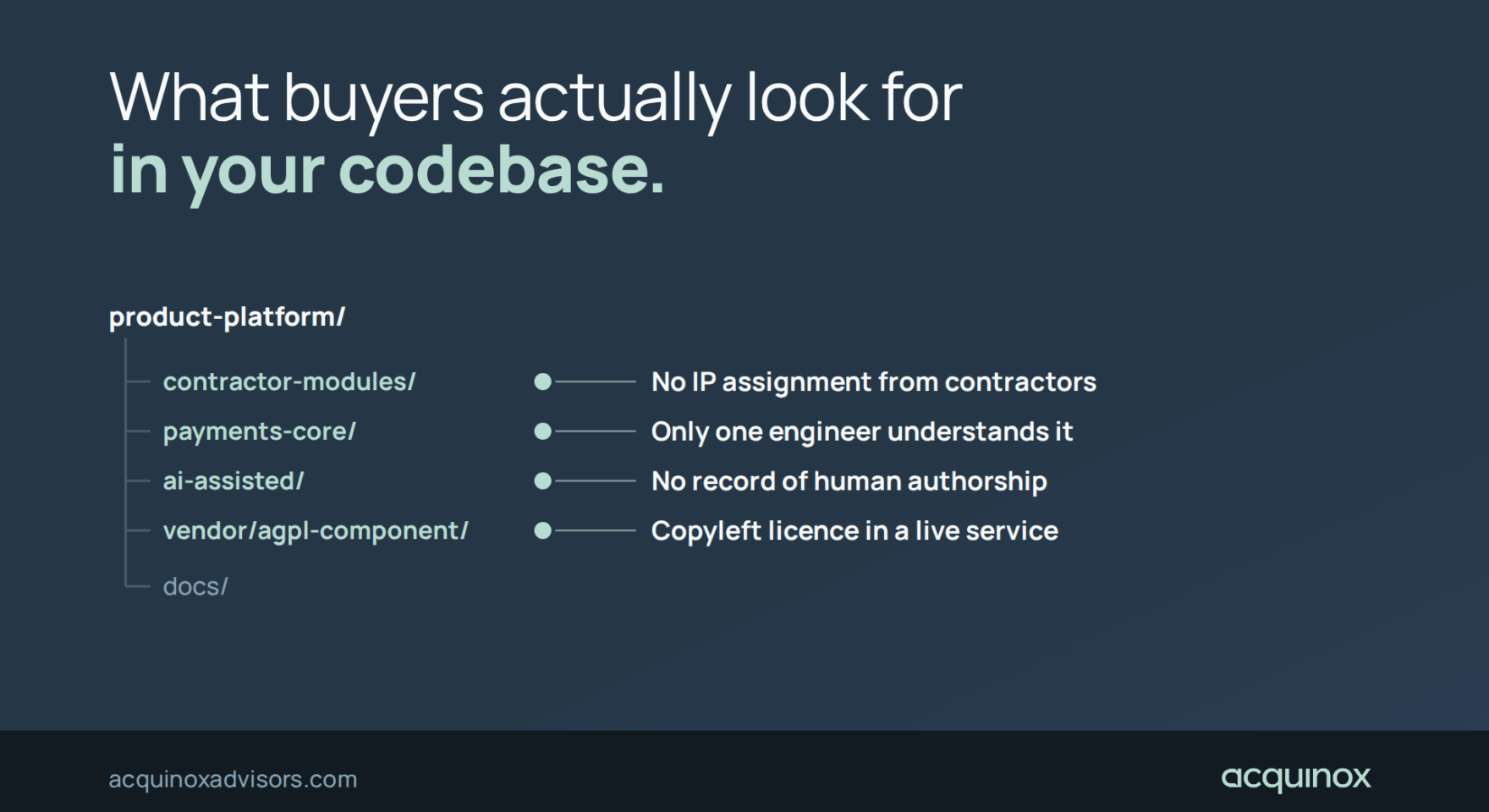
Technical due diligence has evolved past checking code quality. In 2026, buyers assess architecture scalability, key-person dependencies, open-source licence compliance, AI-generated code ownership, contractor IP chain-of-title, deployment maturity, and regulatory readiness amongst other factors. Missing one of these areas may delay or complicate an exit, reduce valuation, or jeopardise a transaction altogether.
Why technical due diligence now arrives early and goes deep
An engineering team just pushed a major release, and revenue is climbing. Then an acquisition letter arrives. Within days, the buyer’s technical adviser requests architecture diagrams, penetration test reports, and open-source inventories. This is the speed and detail of technical due diligence required in 2026.
It now extends to forensic examination of architecture, security and regulatory compliance. Engaging early in exit preparation and M&A advisory is vital because, according to Harvard Business Review, between 70% and 90% of acquisitions fail to achieve their goals. The authors trace most of those failures to poor target selection, overpayment and flawed integration, and technical findings that surface late in a process are directly related to the last two.
For sellers, every undisclosed technical issue becomes an opportunity that buyers can use to reprice deals during diligence or, worse, post-signing.
What buyers actually examine
Architecture scalability: will the system support growth?
Can the system in question handle the scale implied by the buyer’s growth thesis, or will it require a complete rebuild? Diligence teams typically assess horizontal and vertical scalability, whether the system can distribute load across infrastructure or scale up on larger hardware. They examine the software architecture, database sharding strategy, read replica configuration and caching layers.
They also tend to map third-party dependencies to identify single points of failure. A monolithic architecture with no modular boundaries gets expensive to scale and integrate. Microservices, on the other hand, introduce operational complexity that requires sophisticated team maturity to operate reliably.
Proactive technology due diligence advisory helps mitigate these integration risks before talking to potential buyers.
The human factor: key-person dependencies
Software systems have a social architecture as well as a technical one. Key-person dependency analysis measures the concentration of critical knowledge in one or more key individuals. If one of these people leaves, the organisation may suffer disproportionate disruption.
Diligence teams identify key personnel by running Git commit analysis, mapping which engineers authored which components and identifying subsystems with a single contributor. Documentation audits follow, assessing whether architecture decision records and runbooks exist and are current. Any system that a single engineer’s departure would critically impair is a material valuation risk.
Open-source licence compliance: the licence question that matters
Open-source software is ubiquitous in commercial codebases. Most open-source licences, such as MIT, Apache 2.0 and BSD, are permissive and impose minimal obligations. The risk, however, lies in copyleft licences, which impose obligations that may be incompatible with commercial software ownership.
The three copyleft families most frequently encountered are GPL, LGPL and AGPL. GPL obligations are triggered by distributing software, so a product delivered purely as a service rarely engages them, but for SaaS and cloud-native products AGPL exposure is particularly acute. If an application incorporates a modified AGPL component and users interact with it over a network, the company may be obliged to release the corresponding source code, and depending on how tightly the component is integrated, that obligation can extend well into the proprietary application.
According to Black Duck’s 2026 audit data, open source was found in 98% of codebases and 100% of M&A transactions, with licence conflicts identified in 94% of transactions and unpatched vulnerabilities in 97%.
AI-generated code: human auditability and legal ownership risks
The widespread adoption of AI-assisted coding tools has introduced a category of IP risk that many existing policies weren’t designed to handle. For acquirers in 2026, AI-generated code requires a distinct diligence workstream.
US copyright law requires human authorship. The US Copyright Office, for example, has confirmed that works predominantly generated by AI without meaningful human creative input are not eligible for copyright protection, with the UK taking a more permissive approach.
The UK difference is concrete: section 9(3) of the Copyright, Designs and Patents Act 1988 attributes authorship of computer-generated works to the person who made the arrangements for their creation. Within the EU, the Court of Justice has long held that copyright protects only the author’s own intellectual creation, which points in the same direction as the US position and leaves codebases built largely without human creative input exposed in the same way.
The practical implication: a codebase containing substantial volumes of AI-generated code, produced without sufficient human intervention, may contain unprotectable material that cannot be owned, licensed, or assigned.
Buyers therefore want evidence that AI was used as a tool under human direction rather than as the author of the product: that engineers chose the architecture, reviewed and restructured generated output and made the creative decisions that shaped the final code, supported by commit histories, review records and a written policy on AI-assisted development.
Contractor code and the chain-of-title problem
The chain-of-title problem remains one of the most commonly encountered and most deal-disruptive findings. The issue arises from a fundamental misunderstanding: paying for code does not make you the owner of it.
Under US and UK copyright law, independent contractors own the copyright in the work they produce unless there is a written agreement that transfers those rights to the commissioning party.
A company that has used external developers or freelance engineers without obtaining signed IP assignment agreements from each contributor may not legally own that code.
In due diligence, the seller is expected to evidence an unbroken, written line of ownership running from each individual developer to the company itself. A missing assignment is a gap in the legal ownership of the asset being sold.
For founders in continental Europe, the mechanics differ from the US and UK model in ways that change what a clean chain of title looks like. In Germany and Austria, copyright itself cannot be transferred, so contractor agreements must grant exclusive and unrestricted rights of use rather than purport to assign ownership. In Poland, a transfer of authors’ economic rights is valid only in writing and only for the fields of exploitation the agreement expressly lists, which means contractor agreements drafted on a US template frequently leave rights with the developer for any use the contract does not name. Both German and Polish law vest the economic rights in software written by employees in the course of their duties in the employer by statute, which makes the distinction between employees and contractors the real fault line in a European chain-of-title review.
The regulatory dimension: DORA and compliance obligations
Technical due diligence for acquisitions in or adjacent to regulated financial services has a dimension that purely commercial transactions do not.
In the EU, the Digital Operational Resilience Act (DORA), which entered into application in 2025, requires EU financial entities to meet stringent ICT risk management standards. For M&A transactions where the acquirer is DORA-regulated, the target’s technology stack, vendor dependencies, and operational resilience must be assessed against the acquirer’s regulatory compliance baseline from day one post-close, or non-compliance is repriced as a remediation liability.
Pre-market checklist: what to prepare before the process begins
The following checklist addresses the findings most likely to cause deal disruption or valuation adjustment:
| Diligence area | Required preparation |
| IP ownership | Compile a list of every contributor and obtain signed IP assignment agreements, or exclusive grants of rights where local law requires them, from every non-employee. |
| Open source | Generate a software bill of materials (SBOM) and isolate AGPL components, and GPL components in any distributed software, from proprietary code. |
| AI provenance | Document how AI-assisted code was directed, reviewed and modified by engineers, and keep a written policy on AI-assisted development. |
| Technical debt | Quantify architectural debt in business terms, expressed as engineering time and impact on the delivery roadmap. |
| Key-person dependencies | Write current architecture decision records and runbooks for every critical system, and spread knowledge of each core component across more than one engineer. |
| Deployment | Document CI/CD pipelines, deployment frequency and change failure rates. |
| Security | Commission a recent penetration test and keep a log of the findings and how each was remediated, since buyers ask for both early in the process. |
| Regulatory readiness | Where the likely buyer is DORA-regulated, map ICT third-party dependencies and resilience controls against its compliance baseline before going to market. |
How boutique advisers approach technical diligence
For specialist M&A advisers working with technology clients, technical diligence has shifted from an optional workstream to a core component of deal preparation. When preparing for exit or raising capital, these firms embed technical assessment into the pre-market phase rather than waiting for a buyer to uncover risks.
Doing this work early allows the seller to remediate high-impact findings, position architectural decisions transparently, and ultimately protect their valuation. The cost of addressing these issues proactively is substantially lower than negotiating around them during a live transaction. To explore comprehensive exit preparation strategies and secure your company’s valuation, contact us at Acquinox Advisors to initiate your pre-market technical assessment today.