



Every business owner dreams of exiting at the absolute peak—when investor excitement is soaring, multiples are at historic highs, and buyers are competing to outbid each other. The logic seems bulletproof.
But here’s the reality: perfectly timing your exit is nearly impossible. While you’re waiting for all the stars to align, economic conditions shift, buyer enthusiasm cools, and the valuation you could have commanded six months ago becomes a distant memory.
TL;DR: The M&A market has rebounded strongly in 2025, with global deal value reaching $4.8 trillion. While waiting for the “perfect” moment to sell your business, market conditions can shift rapidly. Owners who prepare thoroughly and act when conditions are “good enough” consistently achieve better outcomes than those waiting for perfection.
Key takeaways
- Perfect timing is impossible: Don’t try to time the market’s absolute peak. Conditions can shift in a single quarter.
- The market is recovering: The M&A market has rebounded strongly. Buyers are actively seeking quality businesses right now.
- Waiting has hidden costs: Delaying your sale risks performance decline and can destroy enterprise value. A forced sale later will earn you less.
- ‘Good enough’ is the goal: Aim for ‘good enough’ conditions, not perfect ones. A successful sale needs solid performance and an active market.
- Preparation is everything: Top valuations go to well-prepared businesses. Start organising your finances and operations months in advance.
Table of contents
Why “perfect timing” is a dangerous myth
Markets move fast. Global M&A deal value surged to approximately $4.8 trillion in 2025, up 36% from 2024 (Bain & Company, 2025). US deal volume alone reached approximately $2.3 trillion, up 49% year-over-year (Harvard Law School Forum, 2025). Yet this dramatic rebound followed years of subdued activity since 2021 that caught countless would-be sellers completely off guard.
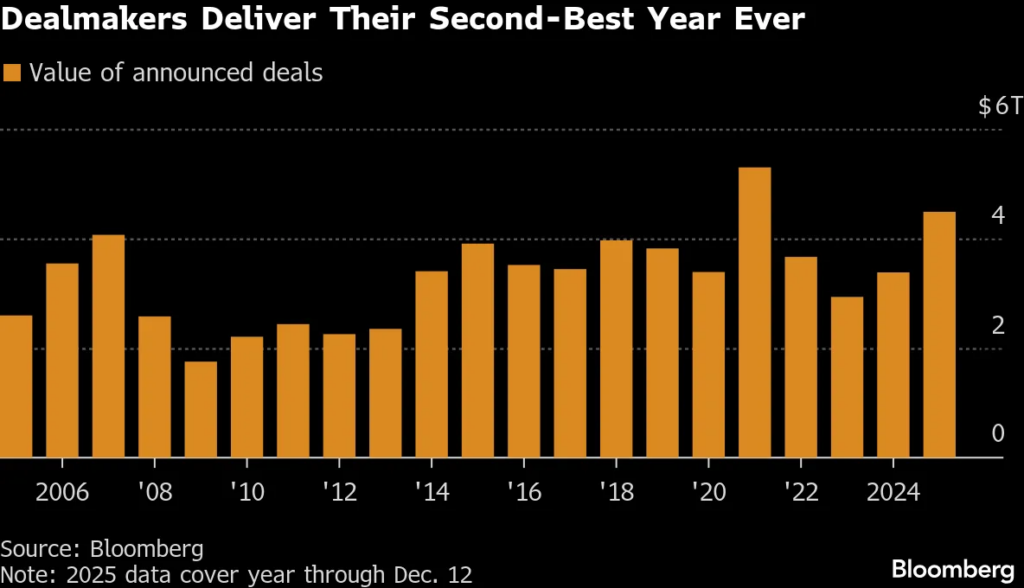
Image Credit: Bloomberg
The conditions that make for an “ideal” sale rarely align simultaneously. Your company might deliver three consecutive years of impressive growth, but then interest rates spike and dampen buyer appetite. Or the economy is booming and private equity firms have capital to deploy, but your star salesperson just resigned, creating a temporary performance dip that complicates negotiations.
Waiting for every variable to line up perfectly is like trying to time the stock market’s absolute peak. Even professional investors with sophisticated analytics and full-time research teams can’t do it consistently. Business owners managing daily operations while trying to predict macroeconomic trends face exponentially longer odds.
The valuation gap that plagued M&A markets through 2023 and 2024 proves this point perfectly. Many businesses considering a sale were dissatisfied with valuations and chose to wait. By the time buyer and seller expectations realigned in 2025, numerous owners had already missed their optimal windows.
The costs of waiting
Delaying your exit destroys enterprise value in ways most owners don’t anticipate until it’s too late.
The emotional trap
Your business isn’t just a financial asset. It’s your identity, your life’s work, your legacy. This emotional attachment makes letting go extraordinarily difficult, even when rational analysis screams that the timing is right.
Owners consistently overestimate their ability to improve performance before a sale. The thinking goes: “If I can just hit that revenue target or land that big contract, I’ll get a much better valuation.”
But what if those improvements never materialise? Your valuation can collapse after one bad year, while building significant value requires several consecutive years of strong results. Many sellers discover too late that what they could have achieved 24 months earlier is now permanently off the table.
The market-timing fallacy
Business owners try to time M&A cycles the same way retail investors try to time stock markets—and fail just as spectacularly.
They wait for multiples to peak, for economic indicators to flash green, for their industry to become the market’s darling. The problem? By the time you recognise that perceived unfavourable circumstances were ideal, that moment has passed.
Recent data reveals a stark reality: companies positioned to benefit from AI tailwinds are seeing outsized multiples and intense deal activity, while companies where AI is viewed as a threat receive fewer credible offers. These dynamics can shift within a single quarter.
Meanwhile, competitors willing to transact at “good enough” valuations are closing deals and moving forward.
Performance decline accelerates quickly
Your business performance can reverse at any moment due to factors entirely outside your control. When revenue growth moderates, the ripple effects compound fast.
Innovation stalls as budgets tighten. Key employees field recruiting calls from competitors. Major customers explore alternative vendors. Each development makes selling exponentially harder.
Some market data suggests that many business owners delayed sale plans in 2024, influenced by concerns about economic stability and lower valuations. This often becomes a self-fulfilling prophecy of decreased exit opportunities.
Buyer fatigue kills deals
If you’ve been “exploring strategic alternatives” for years and have had preliminary conversations with potential acquirers, their patience runs out.
When you repeatedly signal interest without executing, sophisticated buyers draw conclusions. They assume undisclosed problems exist, that your financials are weaker than presented, or that you lack genuine commitment. This reputational damage within the buyer community can permanently impair your ability to secure competitive bids.
Buyers are willing to pay premium prices—but only for companies that demonstrate clear readiness, not businesses with indecisive ownership.
Forced sales destroy value
The longer you wait, the higher the probability you’ll eventually face a forced sale under terrible circumstances.
Health crises don’t announce themselves. Family situations change unexpectedly. Competitive threats emerge rapidly. Many private equity portfolio companies are reaching holding periods of six to seven years, with sponsors under mounting pressure to exit and return capital to investors.
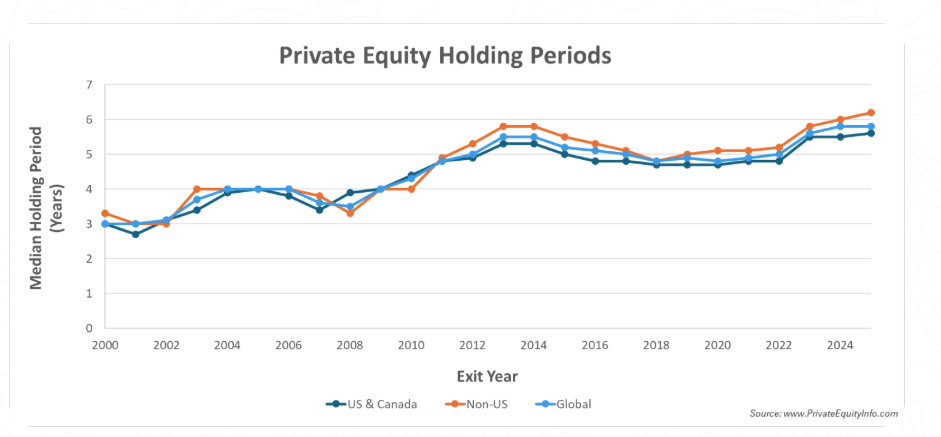
Image Credit: privateequityinfo.com
Additionally, the “silver tsunami” looms as Baby Boomer business owners approach retirement seeking liquidity events. This supply increase could put pressure on valuations across entire sectors.
Recognising your window before it closes
You don’t need perfect conditions. You need good enough conditions combined with preparation.
| Signal | What to Look For |
| Strong Recent Performance | Two to three consecutive years of solid revenue growth, healthy margins, and consistent cash flow. |
| Active Buyer Market | Competitors are being acquired, PE firms are investing in your sector, and you are receiving unsolicited enquiries. |
| Personal Readiness | You have a clear vision for your life after the sale and are emotionally prepared for the transition. |
| Operational Independence | The business runs effectively without your daily involvement, with a capable management team and documented processes. |
In more detail:
Strong Recent Performance. If you’ve delivered two to three consecutive years of solid results, consider initiating discussions. Most business sales take six to twelve months to complete, meaning preparation should begin well before you want to close. Enter negotiations when revenue is expanding or stable, margins are healthy, and cash flow is consistent.
Active Buyer Market. Watch for these signals: competitors in your sector completing acquisitions at attractive multiples, private equity firms actively evaluating opportunities in your industry, and unsolicited inbound enquiries from potential acquirers. This demand creates competitive tension that drives valuations upwards. For companies in aerospace, defense, government services, and various service sectors, a clear exit window is open right now.
Personal Readiness. You’ve reached mental and emotional readiness to transition. You have a clear vision for what comes next—retirement, a new venture, philanthropy, or time with family. Selling a business is emotionally challenging, and many owners underestimate the psychological impact of relinquishing their life’s work.
Operational Independence. Your business functions effectively without you at the centre of every decision. You’ve built a capable management team, documented core processes, and ensured customer relationships aren’t dependent on your personal involvement. For acquirers, the more replaceable the owner, the more valuable the business.
Take action now
Business owners who wait for every condition to align perfectly end up selling later, under worse terms, and for significantly less money than those who prepare thoroughly and move decisively when conditions are favourable.
If you’ve been contemplating an exit within the next two to three years, now is the time to begin preparation. Market conditions are improving, buyers have capital to deploy, and quality businesses are commanding strong valuations. But success in this environment demands preparation.
Your “good enough” moment might be right now. Don’t let it pass while waiting for perfection that will never come.
The businesses achieving premium valuations in today’s market share common characteristics: clean financial records, documented operational procedures, management teams capable of operating without founder involvement, and clear articulation of value drivers. These advantages aren’t created overnight—they require months of deliberate preparation.
This article has been prepared by Acquinox Advisors using data from Bain & Company, Harvard Law School Forum on Corporate Governance, EY-Parthenon, PwC, Private Equity Info amongst others.This content is for informational purposes only and does not constitute financial, legal, or investment advice. Readers should consult qualified professional advisers before making business sale decisions.
FAQ
How long does a business sale actually take?
The average business sale now takes from few months to a year from initial preparation through closing. Complex transactions involving larger enterprises or regulated industries can extend substantially beyond this timeframe. Starting your preparation early gives you more control over timing and reduces pressure to accept unfavourable terms.
Can I still sell if performance declined last year?
Yes, but expect lower valuations since buyers heavily weight recent performance trends. Acquirers are increasingly focused on quality companies with strong cash flow, diverse customer bases, and low leverage. If you’re confident you can orchestrate a turnaround within six to twelve months, that effort may prove worthwhile. Otherwise, selling sooner often preserves more value than waiting for improvements that may never materialise.
How do I know what my business is actually worth?
Initial valuation ranges can be estimated using industry-specific multiples and comparable transaction data or even an AI-powered valuation tool. For precise analysis, speak with an M&A expert who can conduct thorough examinations of your financial performance, competitive positioning, growth trajectory, and current market conditions. Professional valuation provides the foundation for realistic pricing expectations and successful negotiations.