



Key Takeaways:
- Global M&A surged 40% in 2025 to $4.9 trillion – the second-highest on record
- AI adoption in M&A more than doubled; one-third of dealmakers now deploy AI systematically
- Private equity holds approximately $880 billion in US dry powder available for deployment
- Shareholder activism hit record highs with 255 campaigns launched globally
- Technology, healthcare, and energy sectors led deal activity heading into 2026
The boardroom phone won’t stop ringing. A manufacturing CEO finds her third unsolicited acquisition offer this month: two from private equity shops she’s never heard of, one from a Fortune 500 competitor. Her revenue isn’t extraordinary. Her margins are decent. But in early 2026, she’s suddenly everyone’s target.
Welcome to the new M&A reality. After years of cautious sideline-sitting, the deal machine has roared back to life with renewed appetite. Global M&A surged 40% in 2025 to reach $4.9 trillion, delivering the second-highest deal value on record. But 2026 may not be simply more of the same. Three significant forces appear to be reshaping the M&A playbook: artificial intelligence influencing what companies are worth, private equity holding approximately $880 billion in dry powder available for deployment, and activist investors pressuring boards toward transformative action at record levels.
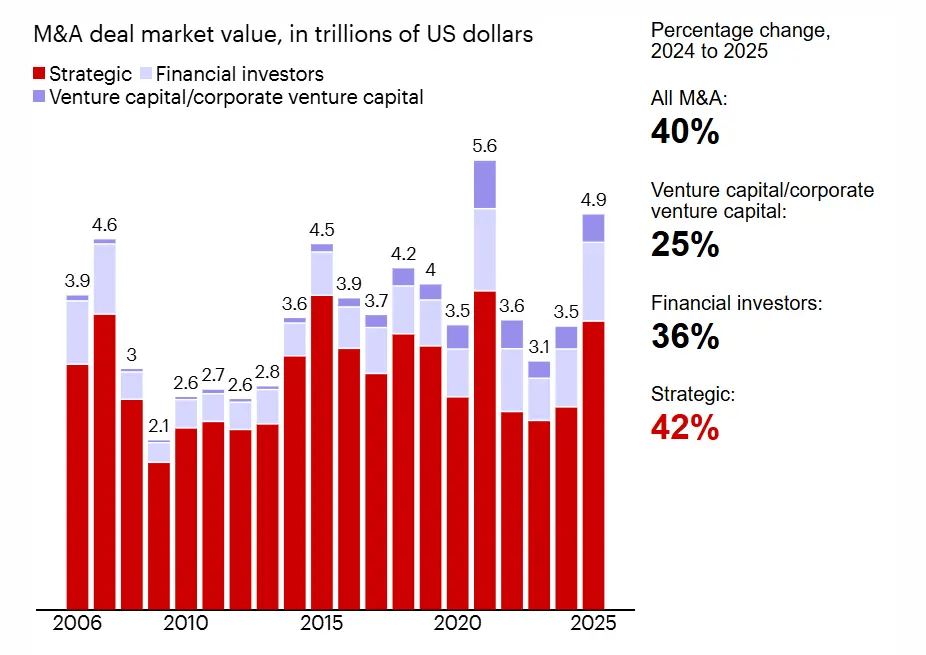
Global M&A volume, source: Bain, Dealogic
The great divide: When size may become destiny
Deal value remained elevated even as volumes stayed muted, with activity concentrated among the largest transactions and best-capitalized buyers. Technology-led megadeal activity in 2025 with substantial deal volume exceeding $5 billion. Electronic Arts’ $55 billion buyout, the largest leveraged buyout on record. exemplifies the scale of capital that moved in 2025.
But here’s the paradox: while megadeals dominate headlines, quality middle-market businesses with differentiated positioning may be positioned to attract competitive valuations precisely because institutional buyers flush with capital seek deployment opportunities.
For middle-market owners, this could create an opportunity. Private equity enters 2026 with significant deployment pressure. Dry powder held by US-based PE funds dropped to about $880 billion in September 2025 from a record high $1.3 trillion just nine months earlier as aggressive deployment accelerated.
But this isn’t 2021, when sponsors paid any price for mediocre assets. Today’s PE buyers tend to demonstrate greater selectivity, prioritizing recurring revenue, defensible competitive positions, and operational leverage. For sellers, this means preparation and thorough due diligence matter more than ever.
AI: A potential value multiplier
AI adoption in M&A more than doubled in 2025, with one in three dealmakers now deploying AI systematically or redesigning processes around it. But AI’s impact may extend far beyond process efficiency, it appears to be fundamentally influencing valuations.
Technology M&A increased 66% year-over-year to approximately $1.08 trillion, driven by AI, data infrastructure, and cybersecurity transactions. Almost half of all deals in the technology industry already have an AI angle, a trend that appears to be accelerating.
For business owners, implications may be significant. Sellers should consider documenting AI implementations, data assets, and digital infrastructure before approaching the market. Companies lacking AI strategies or possessing inadequate data infrastructure may face buyer skepticism and potential valuation discounts.
Activists: The shadow dealmakers
Shareholder activism reached record levels in 2025. Activists launched a record 255 campaigns globally, surpassing the 2018 record. In North America alone, campaigns increased 20% year-over-year. Notably, over 40% of US activist campaigns explicitly included M&A components demanding sales, spin-offs, or strategic transactions.
Activists secured 98 board seats in the US in 2025, a 28% year-over-year increase. For business owners, the implications split two ways. First, companies considering selling may benefit from acting proactively rather than waiting for activists to force the agenda. Second, acquirers monitoring activist campaigns may identify attractive targets where pressure creates transaction tension.
Where the action has concentrated
Technology: Tech remained highly active in 2025, with cybersecurity, data infrastructure, and cloud services attracting strong multiples. Targets demonstrating modern tech stacks may command premiums; those with legacy systems may face discounts.
Healthcare: Global health M&A values rose 46% in 2025 despite volume drops, underpinned by 11 megadeals. Digital health and AI-powered platforms appear to attract particularly strong interest in diagnostics, remote monitoring, and value-based care. Medtech deal value surged to $92.8 billion, the highest in over a decade.
Financial Services: Banking consolidation showed increased momentum in 2025. Regulatory timelines for regional bank deals have reportedly shortened. Fintech M&A is expected to continue as traditional players seek to acquire digital capabilities.
Energy: Renewable assets with secured power purchase agreements and favorable grid interconnection have tended to command premiums. Even fossil fuel assets can find buyers when providing reliable baseload capacity, though valuations may face ESG headwinds.
What sellers should consider doing now
Selling successfully in 2026 typically requires 12-24 months of preparation. Organise and audit financials for at least three years. Consider engaging qualified firms to conduct quality of earnings analyses demonstrating sustainability. Clean financials tend to signal professionalism and may reduce buyer concerns.
Document your AI and technology posture. Buyers increasingly scrutinize AI capabilities, data infrastructure, and digital sophistication. Create operations manuals documenting critical processes. Strengthen management teams to demonstrate that businesses can operate without daily owner involvement. Address legal and compliance issues proactively before buyers uncover them.
Price realistically using current market comparables and valuation multiples, not 2021 peak multiples. Companies demonstrating pricing discipline and transparency tend to experience faster processes and better outcomes.
What buyers should consider doing now
Consider deploying AI throughout acquisition processes. Use AI-powered platforms for target identification, document review, and valuation modeling. AI adoption in M&A workflows is projected to reach 80% within three years. Early adopters may gain meaningful speed advantages.
Build proprietary deal flow through intermediaries, industry executives, and professional service providers. Launch integration planning during exclusivity periods, not after closing. Industry research suggests companies implementing disciplined integration approaches tend to capture more value than peers with ad hoc approaches.
Structure deals appropriately. Consider using earnouts to bridge valuation gaps when uncertainty exists. Representations and warranties insurance can shift breach risk to carriers.
The 2026 window
The manufacturing CEO ultimately decided to engage with buyers. Her company wasn’t desperate, but market conditions appeared compelling: an improving valuation environment, multiple qualified bidders, and strategic buyers offering integration pathways that could accelerate growth.
Her experience may capture 2026’s essential dynamic. This may not be a market for reactive responses. It appears to demand strategic proactivity, whether selling, buying, or simply managing in M&A-intensive sectors. Based on current indicators, 2026’s M&A market appears poised to remain active. The question is whether you’re ready to capitalize.
Ready to explore your strategic options? Contact Acquinox Advisors for expert M&A guidance tailored to your business goals.
Frequently Asked Questions
What is the current state of the M&A market in 2026?
Global M&A activity surged 40% in 2025 to $4.9 trillion, the second-highest deal value on record. Deal activity is expected to remain elevated in 2026, driven by private equity deployment pressure, AI-related acquisitions, and continued megadeal activity, though overall deal volumes remain muted compared to peak years.
How long does it take to prepare a business for sale?
Selling successfully typically requires 12 to 24 months of preparation. This includes organising and auditing financials, documenting AI and technology capabilities, strengthening management teams, addressing legal and compliance issues, and engaging qualified advisors for quality of earnings analyses.
What sectors are most active in M&A currently?
Technology, healthcare, and energy sectors led deal activity in 2025. Technology M&A increased 66% year-over-year, driven by AI and cybersecurity transactions. Healthcare M&A values rose 46%, underpinned by 11 megadeals. Medtech deal value reached $92.8 billion, the highest in over a decade.
This article has been prepared by Acquinox Advisors using data from public sources as linked. This content is for informational purposes only and does not constitute financial, legal, or investment advice. Readers should consult qualified professional advisers before making business sale decisions.